Cabinet Refacing vs. Full Replacement: Cost, Lifespan, and When Each Makes Sense
Get the honest breakdown so you make the right choice.

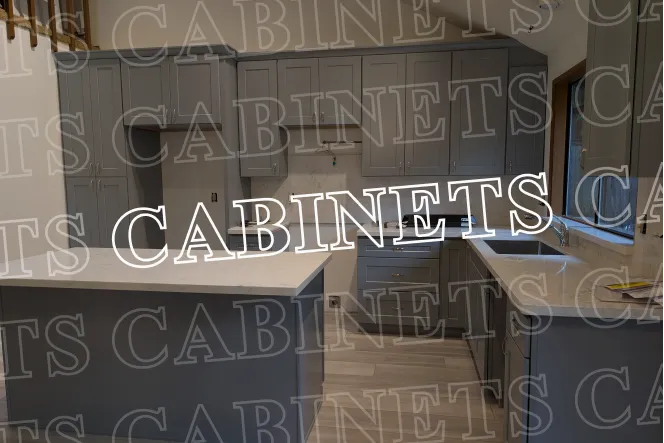
Your cabinet doors are dated, the finish is worn, and every time you walk into the kitchen you think the same thing: these have to go. Then you price out new cabinets, and the sticker stops you cold.
Here is the part most homeowners never hear clearly. You may not need new cabinets at all. If the boxes behind those tired doors are still solid, refacing or refinishing can update the whole look for less than a full replacement. But that is only half the story, and the internet almost never tells you the other half: a quality refacing job is not cheap, and depending on what else you want to change, it can cost about the same as new cabinets.
This guide lays out the real costs, how long each option lasts, and a clear way to tell which side your kitchen falls on. No sales pressure, the same straight answer we give homeowners across Tacoma and Pierce County every week.
Should You Reface, Refinish, or Replace?
Before we touch cost, let's clear up three terms that get mixed together constantly. They sound similar. They are not the same project, and the difference decides everything that follows.
Refinishing is the lightest touch. You keep your existing doors and drawer fronts and give them a new coat of paint or stain. Same doors, same hardware holes, different color. It works well when your doors are a style you still like and only the finish has aged, or when the real problem is a look you have outgrown rather than any damage.
Refacing goes a step further. The old doors and drawer fronts come off and brand-new ones go on, while a fresh veneer or skin gets applied over the exposed sides and face frames of your existing boxes. New hardware usually comes along too. What stays is the structure: the boxes stay bolted to the wall, your sink and appliances stay put, and the footprint of the kitchen does not change. What changes is everything you see and touch.
Full replacement is exactly what it sounds like. The old cabinets come out completely, boxes and all, and entirely new cabinetry goes in. New boxes, new doors, new drawers, new everything. This is the only option that lets you change the layout, fix the storage, and upgrade the actual construction of the cabinets.
Here is the quick version, side by side:
Most of this guide compares refacing and replacement, because that is the real fork in the road for the majority of Tacoma homeowners. Refinishing is a fine option, but it solves a smaller problem.
What Refacing vs. Replacing Costs
This is the part you actually came for, so let's be straight about it. Most articles on this topic dance around real numbers. We will not.
Refacing is usually cheaper than a full replacement, for one simple reason: you are not paying to build and install new boxes, and you are not paying to demo and haul away the old ones. But here is the part homeowners rarely hear. A good refacing or refinishing job, done by someone who uses the right materials and knows what they are doing, is not cheap. Done well, it can land close to the price of a fresh set of stock cabinets.
So where do the savings really come from? Not from the cabinet work being cheap. They come from everything you get to leave alone: your countertops, your backsplash, your plumbing, all of it stays put. That is the whole case for refacing, and it only holds when leaving those things alone is what you actually want.
Here is how the three paths compare in the Tacoma and Pierce County market in 2026:
A few things worth knowing as you read those numbers.
The refinishing and refacing figures are regional and national averages. Those are not our services with a set price list, so we would rather give you honest market ranges than invent numbers. The replacement figures are ours, straight from the Tacoma jobs we quote, and they cover the cabinetry only. Labor can push the stock number higher depending on the kitchen, but that spread holds for most homes.
Those replacement numbers also line up with our Tacoma kitchen remodel cost guide, where cabinets typically eat up 30 to 40% of a total remodel budget. Once you add countertops, demo, plumbing, and the rest, a full cabinet replacement lives inside the larger mid-range remodel range of $30,000 to $50,000.
Refacing, by contrast, usually fits inside what we call a minor refresh: a smaller scope that also covers new hardware, paint, lighting, and a faucet. You get a kitchen that reads as new without the budget of a full remodel, as long as the boxes underneath are worth keeping.
One note on that last column: those lifespans are averages. How long a set actually lasts comes down more to how the cabinets are treated than the year they were built.
And there is the catch. Put gorgeous new doors on boxes that are swelling, sagging, or built from crumbling particle board, and you have dressed up something that is going to fail anyway. At that point you pay twice: once to reface, and again to replace a few years later. So which side are you on? Usually, you already know.
When Refinishing or Refacing Is the Smart Move
Most homeowners do not need a formal inspection to know where they stand. If the boxes are sound and nothing is actually broken, keeping them is usually the right call. Refinishing or refacing tends to be the move when most of these are true:
- The boxes are solid and you simply do not like the look. No damage, no water, no sag. You have outgrown the color or the style, and a refinish fixes exactly that for the least money.
- You recently updated your countertops and backsplash. This is the big one people miss. If you put in new counters and a new backsplash a few years ago and they still look great, replacing the cabinets means tearing all of that back out. In that case you lose. Refinishing lets you refresh the cabinets without destroying newer work you already paid for.
- You like your current layout. The kitchen already works for how you cook and live, and you are not itching to move the sink or knock out a wall.
- You are working within a budget. Everything else in the room still holds up, and you want an update, not a full project.
- You want it done fast. Refinishing and refacing wrap in days, not weeks, with far less disruption to daily life.
If you are weighing a refresh on a smaller or awkward kitchen specifically, our guide to small kitchen remodel ideas for Tacoma homes pairs well with a refinishing plan.
When You're Better Off Replacing
You will usually know when the boxes are truly done, and it is rarely subtle: a sink base gone soft or stained from a slow leak, a smell baked into the wood that no new door will cover, particle board that is swelling or crumbling. When that is what you are dealing with, replacement is the better investment, and the same goes any time the job calls for more than a new face:
- The boxes are damaged or low quality. Water damage, warping, sagging shelves, a smell you cannot get out, or particle board that is breaking down all mean refacing would be throwing good money after bad.
- You want to change the layout. Moving the sink, adding an island, opening a wall, or reconfiguring the work triangle is only possible with new cabinets. Worth noting: layout changes that touch plumbing, electrical, or structure will also need a permit in Tacoma. Our guide on whether you need a permit to remodel a kitchen in Tacoma walks through exactly when.
- You need more or smarter storage. Deep drawers, a tall pantry, corner solutions, and pull-outs come with new cabinetry, not with refacing.
- You are already planning to update the counters and backsplash. Here is the one that catches people. If you are going to replace the countertops and backsplash anyway, replacing the cabinets at the same time is almost always the smart move. Do the surfaces first and swap cabinets later, and you have to tear all that new work back out to reach the boxes. Might as well do it all at the same time.
That last point is the quiet truth of most kitchen projects: once you are touching enough of the room, you are already remodeling it, and the cabinets are the moment to decide whether you do it once or twice.
A Hybrid Approach As a Third Option
Here is something most articles skip entirely, because most companies only want to sell you one thing. Your kitchen does not have to be all reface or all replace.
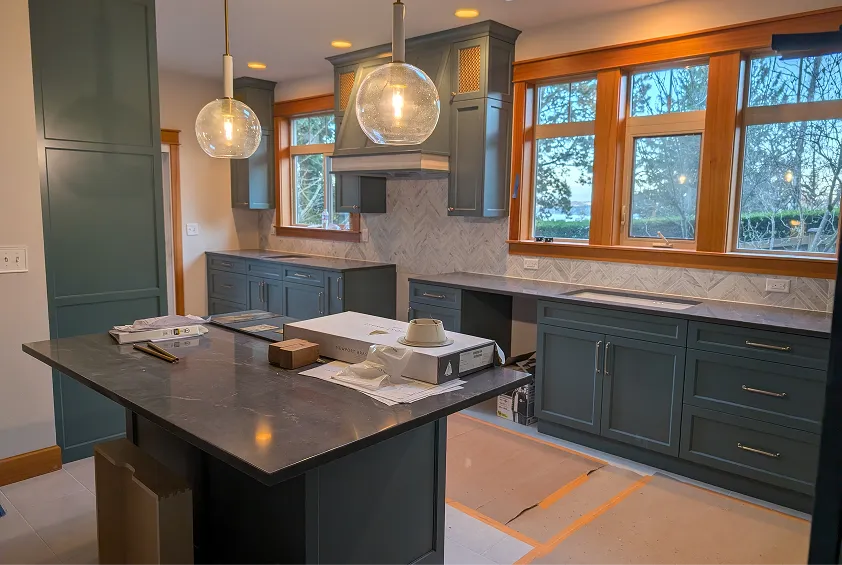
When your kitchen is a mixed bag, a hybrid approach often wins. Say the sink base is water-damaged but the rest of the run is solid. We can replace the box behind the bad cabinet and keep the door face, or swap just that unit and refinish the rest. You end up paying replacement prices only where you have to.
There is a neat trick this opens up, too. You can replace base cabinets without pulling off the countertop, by supporting the counter and working underneath it. We do it that way on a lot of insurance and water-damage jobs. It is more labor, but sometimes it is well worth it to save good upper cabinets and countertops you would rather not lose.
The catch is that a hybrid only works when someone reads the kitchen correctly up front. Done wrong, you get mismatched finishes and seams that never line up. Done right, no one can tell which boxes are new and which were saved. This is exactly the kind of judgment call worth getting a professional eye on.
The Difference Between Stock, Semi-Custom, and Custom Cabinets
When you do replace, you are choosing between three grades of cabinet, and the names cause a lot of confusion. Here is how they actually work.
Stock cabinets are pre-made in fixed sizes, stepping up in three-inch increments: 9, 12, 15, 18, 21 inches, and on up. You build your layout around the sizes that exist, then buy them off the shelf. Some are made overseas, some are made right here locally. Do not let the word "stock" fool you into thinking cheap or limited. Every layout works on stock, the color selection today is huge, and the range runs from basic and affordable all the way up to lines that are genuinely high-end.
Semi-custom is stock with more range: the same idea, better quality, and a set of upgrades and modifications you can add on.
Custom means everything is built to your exact layout. Nothing is pre-made. It is the most expensive path, and it is the one to reach for when a room has odd angles or you want every cabinet to be its own thing.
For most kitchens we do, good stock and semi-custom cabinets get you a result that looks and lasts like far more than you paid. Our Bonney Lake kitchen transformation used quality stock cabinets, and no one walking into that kitchen would ever guess it.
Where to Buy Cabinets in the Tacoma Area
When we replace cabinets, we send most homeowners to sources we trust for good quality at a fair price. If you are shopping stock or semi-custom, two are worth knowing.
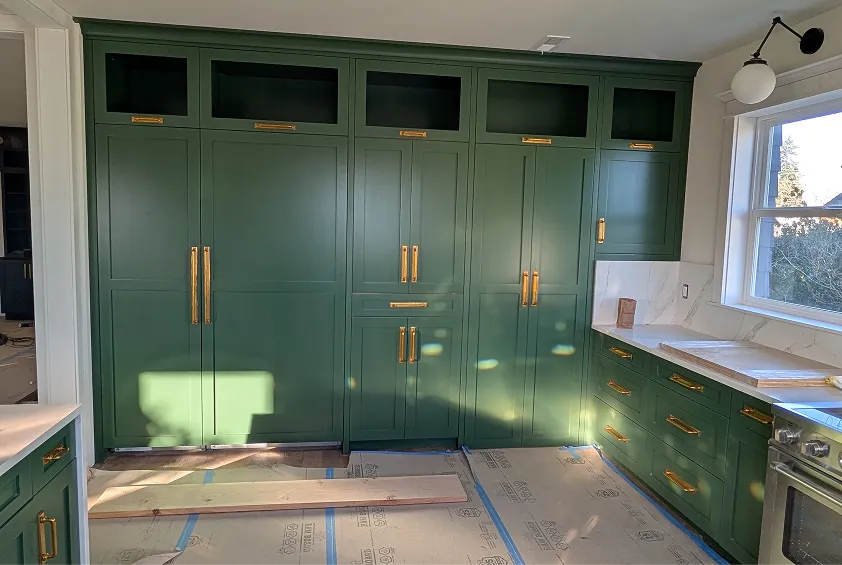
Krafter's Land Cabinetry has a showroom right on Tacoma Mall Boulevard, and it is where we point most homeowners looking for a solid, affordable set. The selection has grown a lot: a ton of colors and several door styles, at prices that stay among the most competitive around even after the recent tariff bumps.
ProCraft Cabinetry is the other we like, built on furniture-grade plywood with quick turnaround, which matters more than people expect.
That turnaround point is worth a warning. Some semi-custom lines are manufactured out of the country, and if a piece is wrong or missing, you can wait weeks for the replacement part. We had one kitchen that started in February and did not finish until May, held up by exactly that. When we spec a job, lead time is part of the decision, not an afterthought.
Resale and ROI: What You Actually Get Back
Both options can lift your home's value, but they do it differently.
Updated kitchens rank among the highest-return improvements a homeowner can make, and the current numbers make the case better than we could. In the 2025 Cost vs. Value Report, a minor kitchen remodel in the Seattle area recoups about 118% of its cost at resale: one of the few home projects that hands back more than you put in. Step up to a major midrange remodel and the return drops to roughly 53%, and a high-end upscale remodel lands closer to 39%. The lesson is not to spend more. It is the opposite: a sensible, well-scoped update returns far better than a top-of-the-market gut job.
A clean refinish also photographs well, and photos are what move a listing. But full replacement signals something a refinish cannot: lasting quality, real construction, better storage, a smarter layout. If you are selling in the next year, a refresh often delivers the better return on dollars spent. If you are staying, replacement's durability and design freedom usually justify the larger outlay.
One caveat: resale value depends on the whole kitchen feeling like one project. New doors next to a cracked laminate counter and dated lighting will not land the same way. A refresh works best when the rest of the room already supports it, which is exactly why so many homeowners who start with "just the cabinets" end up doing more.
Our Honest Take
After more than eight years of remodeling kitchens across Pierce County, here is what I tell people who call us torn between the two.
The boxes decide it. Not your budget, not the calendar, not what your neighbor did. If your cabinet boxes are sound and you like your layout, keeping them is often the smarter move, and I will say that even though replacement is the bigger job for us. If refinishing is genuinely your best path, I will point you there, and if the work is outside what we do, I will tell you that too.
Let me show you why condition beats age. My house and my neighbor's were built the same year, back in 1993. When I bought mine in 2022, the cabinets had to go: multiple owners had run them into the ground, and the smell inside the boxes alone was enough. My neighbor's house had one careful owner the whole time, and his cabinets from that same year still look fine today. Same cabinets, same street, completely different outcome. That is why I do not put much stock in "cabinets last X years." I put stock in how they were treated.
Now here is the pattern I see most. Someone calls wanting a new look, and they also mention they have been meaning to update the countertops and the backsplash. Once all three are on the table, refinishing the cabinets stops making sense. You would refinish the boxes, then tear them back out weeks later to fit the new counters. At that point you are not deciding between reface and replace anymore. You are planning a kitchen remodel, and the smart move is to do it once, do it right, and get decades out of it instead of years.
That is the whole job, really: telling you the truth about your kitchen, even when the answer is bigger, or smaller, than you were hoping. If you want a straight read on which path fits, our team gives free in-home assessments across Tacoma, Gig Harbor, Puyallup, Steilacoom, Lakewood, and the rest of Pierce County. We will look at your cabinets and tell you honestly whether to refinish, replace, or do a bit of both, and if it turns out you are ready for the full kitchen remodel in Tacoma, we will show you exactly what that looks like. You can also see how long a Tacoma kitchen remodel actually takes, week by week, before you commit to anything.
Frequently Asked Questions
Is it cheaper to reface or replace kitchen cabinets?
Refacing is usually cheaper than a full replacement, because you keep the existing boxes and only change the doors, drawer fronts, veneer, and hardware. But a quality refacing job is not cheap, and it can land close to the cost of new stock cabinets. The real savings come from leaving your countertops, backsplash, and plumbing untouched, which only helps if keeping those is what you actually want.
Is cabinet refacing worth it?
For a kitchen with solid boxes, a layout that already works, and counters and backsplash you want to keep, yes. You update the look for less than a full remodel, finished in days instead of weeks. It stops being worth it when the boxes are damaged, when you need to change the layout, or when you are already planning to replace the counters and backsplash anyway.
How long does cabinet refacing last?
A professionally installed refacing job over sound boxes generally lasts 15 to 20 years. New cabinets can last 25 to 30 years or more, while a simple refinish usually holds up 5 to 7 years. How long any of them actually lasts depends heavily on how the cabinets are treated, not just the calendar.
Can you reface old cabinets?
Often, yes. Cabinet age matters less than cabinet condition. We have seen boxes several decades old that were still perfectly sound. The real question is whether the boxes are solid, level, and free of water damage and odor, not the year they were built.
What are the downsides of refacing?
Two main ones. First, it requires structurally sound boxes, so water-damaged or crumbling cabinets are not candidates. Second, it cannot change your layout. If you want to move the sink, add an island, or reconfigure the kitchen, you need full replacement.
What is the difference between stock, semi-custom, and custom cabinets?
Stock cabinets are pre-made in fixed sizes that step up in three-inch increments, and you build your layout around them. Semi-custom is the same idea with better quality and more upgrade options. Custom means everything is built to your exact layout, with nothing pre-made. Good stock and semi-custom cabinets cover the large majority of kitchens beautifully.
Make the Right Call for Your Kitchen
It comes down to your boxes and your plans. If they are sound and the rest of the kitchen is staying put, refinish or reface. If they are worn, you want a new layout, or you are already redoing the counters and backsplash, replace. And when it lands somewhere in between, a hybrid gives you the best of both.
The honest read is worth getting before you spend a dollar, and we are glad to give you one with no pressure and no obligation.
Get your free kitchen remodel estimate. We will walk your kitchen, check your boxes, and give you straight pricing on every option that fits.