Do I Need a Permit to Remodel My Kitchen in Tacoma? (2026 Guide)
Discover exactly when you need a permit, what it costs, and how to get one fast.


Planning a kitchen remodel in Tacoma? The first question most homeowners ask is the same one: Do I actually need a permit for this?
The honest answer is that it depends on what you're changing.
Swap out your countertops and paint the walls? No permit needed.
Pull down a wall to open up the kitchen, move your sink to the island, or add circuits for a new induction range? Now you're in permit territory — and in Tacoma, that means navigating a process that's a little more involved than most cities.
Tacoma has its own building department, its own electrical utility handling permits independently from the state, and as of February 2025, brand-new zoning rules that affect what you can even build in the first place. It's not complicated once you understand the system, but it's easy to get tripped up if you're going in blind.
This guide covers exactly what requires a permit and what doesn't, how the process works step by step, what it'll cost, and the Tacoma-specific quirks that catch homeowners off guard.
Whether you're planning a cosmetic refresh or a full open-concept remodel, you'll know where you stand by the end. (For the rest of the planning picture, see what a Tacoma kitchen remodel costs in 2026 and how long it actually takes.)
TL/;DR If Your Time Is Short
✅ No permit needed for painting, new countertops, replacing cabinets, or swapping a faucet or fixture in the same spot.
🚧 Permit required if you're moving walls, relocating plumbing, adding electrical circuits, installing a ducted range hood, or touching gas lines.
⚡ Tacoma-specific: Electrical permits go through Tacoma Power — not the city, not the state. You'll need two separate permit applications for most full kitchen remodels.
⏱️ Timeline: Tacoma's current average is about 14 business days from a complete submission to permit issuance — one of the fastest turnarounds in the region.
💰 Cost: City permit fees for most kitchens run about $300–$1,250 depending on size and scope, and Tacoma Power's electrical permit starts at $73.
Free tool · Tacoma permit rules 2026
Does your remodel need a permit?
Tick everything you're planning. You'll see which permits you need, who issues them, what they cost and how long they take.
We handle all of this for you.
Every quote we give includes pulling the permits and scheduling the inspections, listed as a line item so nothing catches you off guard.
Where should we send your quote?We'll reach out to set up your free in-home consultation. Your checklist above is already attached.
Do You Need a Permit to Remodel Your Kitchen in Tacoma?
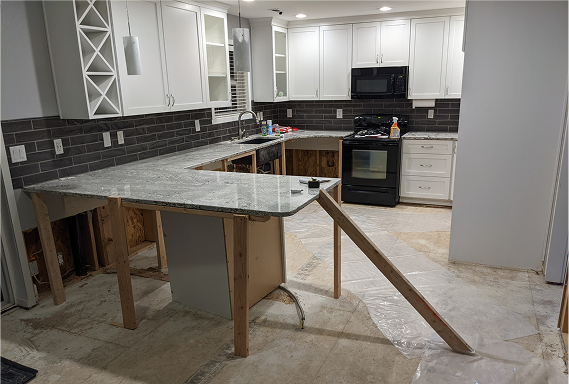
The rule of thumb is simple: if you're changing how your kitchen looks, you probably don't need a permit. If you're changing how it works — the plumbing, electrical, gas, or structure — you do.
Here's how that breaks down in practice.
No Permit Required

Under Tacoma Municipal Code 2.02.540, certain cosmetic and like-for-like improvements are explicitly exempt from the permit requirement.
If your remodel stays within these boundaries, you can get started without a trip through the city's permitting portal:
- Painting walls or refinishing surfaces
- Replacing cabinets or countertops, as long as you're using the exact same footprint
- Installing new flooring (tile, hardwood, LVP)
- Swapping out a faucet, sink, or dishwasher in the same location without moving any supply or drain lines
- Replacing appliances in place (same location, same energy source)
- Installing new cabinet hardware, light fixtures, or a backsplash
The key phrase in all of these is same location. The moment you move something, even a few feet, the exemption evaporates.
Permit Required

Any work that touches the underlying infrastructure of your kitchen requires a Residential Alteration Permit (BLDRA) through the City of Tacoma.
According to Tacoma Permits, that includes:
- Removing or moving a wall. Load-bearing or not. Even non-structural partition walls require a permit if they're being relocated.
- Moving plumbing. Relocating a sink, adding an island with a drain, or trenching a slab to run new drain lines all trigger the permit requirement.
- Adding or upgrading electrical circuits. A new circuit for an induction range, a dedicated microwave circuit, under-cabinet lighting on a new run, or a panel upgrade all require a permit. In Tacoma, this goes through Tacoma Power, not the city building department. More on that in the next section.
- Installing a ducted range hood. If the exhaust vents through the wall or ceiling to the exterior, a mechanical permit is required. And if the hood exceeds 400 CFM, Tacoma's building code requires a makeup air system to go with it. That detail catches a lot of homeowners off guard.
- Adding or relocating gas lines. New gas infrastructure, or moving an existing line to accommodate a relocated range, requires a permit and a pressure test before the line can be connected to the live meter.
- Opening or enlarging exterior walls. Adding a window over the sink, replacing a small window with a sliding glass door, or adding an exterior door to a new deck all require permits and trigger exterior elevation review.
- Adding a second kitchen under Home in Tacoma rules. Under Tacoma's updated zoning (effective February 2025), adding a fully functional second kitchen to a basement or garage is now legal citywide. But it comes with its own set of multi-family building requirements that go well beyond a standard kitchen remodel permit.
The Key Point
The permit exemption under TMC 2.02.540 covers surface work. The moment you open a wall, move a pipe, run a new wire, or touch a gas line, the exemption ends and the BLDRA begins.
If you're still not sure whether your specific project crosses the line, Tacoma's Planning and Development Services department is accessible and genuinely helpful before you start. You can submit a question directly through the Tacoma Permits portal before breaking ground.
It's worth the 10-minute conversation. Getting caught with unpermitted work mid-project is a much harder situation to be in.
Tacoma-Specific Quirks You Need to Know

Most permitting guides are written for a generic city with a single building department. Tacoma doesn't work that way.
There are a handful of quirks specific to Tacoma that can derail a kitchen remodel before it starts, if you don't know they're coming.
Quirk #1: Electrical Permits Are Handled by Tacoma Power, Not the City
This is the one that surprises almost every homeowner doing their first major remodel in Tacoma.
In most Washington cities, electrical permits are issued by the Washington State Department of Labor and Industries (L&I). In Tacoma, that authority belongs entirely to Tacoma Power, the city's municipal utility.
Tacoma Power issues its own permits, conducts its own inspections, and uses its own separate online portal. The city building department has no involvement in the electrical side of your project.
A kitchen remodel that involves both plumbing and electrical work requires two parallel permit applications running at the same time.
One goes through the Tacoma Permits portal for the structural, plumbing, and mechanical work. The other goes through Tacoma Power's portal for everything electrical.
Two applications, two inspection tracks, two sets of fees, and two inspectors who both need to sign off before your project is complete.
The practical implication for scheduling: your electrical rough-in inspection must be completed and approved by a Tacoma Power inspector before the city's building inspector will clear the general rough-in framing inspection.
Plan for that sequencing from the start, or it will create delays mid-project.
Quirk #2: Home in Tacoma Changed What a "Kitchen Remodel" Can Mean
In November 2024, the Tacoma City Council passed Home in Tacoma Phase 2, which became effective February 1, 2025.
The legislation abolished single-family-only zoning across the city, replacing it with flexible Urban Residential zones that now allow duplexes, triplexes, and accessory dwelling units (ADUs) on virtually any residential lot.
For kitchen remodels, this matters in one specific and significant way.
Previously, adding a fully functional second kitchen to a basement or detached garage was either prohibited outright or required a difficult variance process. Under the new Urban Residential zoning, it's now legal citywide.
But legal doesn't mean simple.
Converting a basement into an ADU with its own kitchen triggers a different class of building requirements entirely.
You'll need fire-rated separations between dwelling units, specific acoustic insulation between floors, and separate utility metering coordinated through Tacoma Public Utilities. A standard BLDRA permit won't cover it.
If this is the direction you're heading, it's worth a conversation with a contractor or the city's Planning and Development Services team before you draw up any plans.
For homeowners doing a standard single-family kitchen remodel, Home in Tacoma doesn't change anything. But it's worth knowing about, because the rules around second kitchens changed meaningfully in early 2025.
Quirk #3: On-Site Septic? You Need a Health Department Review First
Most Tacoma homeowners are connected to the city's sanitary sewer system. But properties on the urban periphery, or in areas where the sewer network hasn't reached, rely on on-site sewage systems (OSS).
If your property is one of them, there's an extra step that has to happen before the city will even accept your building permit application.
The Tacoma-Pierce County Health Department (TPCHD) has jurisdiction over all on-site septic systems across Pierce County, including properties within Tacoma city limits.
Any remodel that alters the home's physical footprint, changes the number of bedrooms, or could potentially affect the septic drainfield requires a formal Remodel Project Review by TPCHD before the city will process your permit.
The review exists to make sure your remodel doesn't physically encroach on your septic tank, pump chamber, or drainfield, and that it doesn't pave over the legally required reserve area held for future drainfield replacement.
Per the TPCHD fee schedule, this review is billed at $230 per hour.
If you're not sure whether your property is on septic or sewer, your contractor can check, or you can contact TPCHD directly.
Don't assume. Finding out mid-application adds weeks to your timeline.
Quirk #4: Historic Districts Add One More Layer
If your home is in the North Slope Historic District, the Stadium District, or another area covered by Tacoma's historic preservation overlay, and your kitchen remodel touches anything on the exterior of the home, you'll need approval from the Tacoma Landmarks Preservation Commission (LPC) before the city issues your building permit.
The LPC's authority is limited to exterior character-defining elements. A purely internal remodel, new cabinets, moved walls, updated appliances, reconfigured layout, falls entirely outside their purview.
But modern kitchen design often involves bringing in more natural light, and that's where the LPC becomes relevant. Enlarging a window over the sink, replacing historic wood windows with modern vinyl, or adding an exterior door to access a new deck all trigger mandatory LPC design review.
The commission evaluates changes against the U.S. Secretary of the Interior's Standards for Rehabilitation. Secondary elevations (side and rear) are generally treated with more flexibility than street-facing facades. But the review process adds time to the front end of your project, and it needs to happen before the standard structural review begins. If you think your home might be in a historic district, you can check through Tacoma's Planning and Development Services.
How to Get a Kitchen Remodel Permit in Tacoma: Step by Step
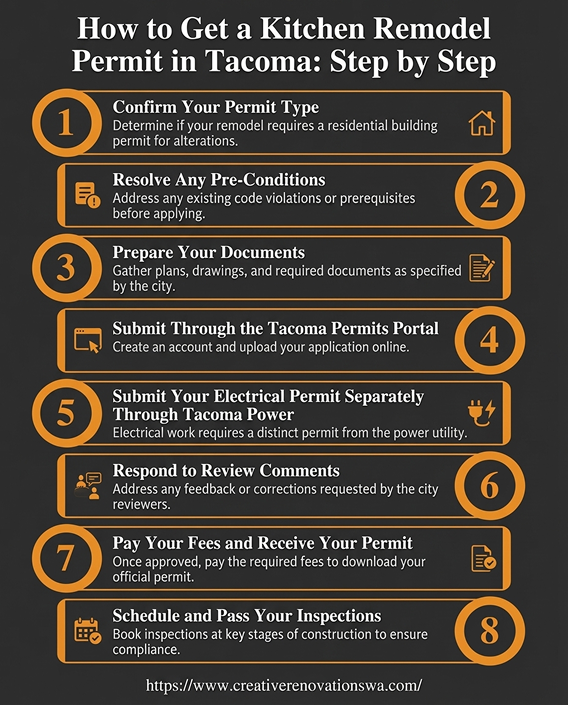
Once you've confirmed your project needs a permit, the process is more straightforward than most homeowners expect.
Tacoma has moved its entire permitting system online, and the city's current average turnaround from a complete submission to permit issuance is 14 business days.
The keyword there is complete.
An incomplete or incorrectly formatted submission gets rejected at intake and restarts your clock entirely.
Here's exactly what the process looks like from start to finish.
Step 1: Confirm Your Permit Type
Most kitchen remodels in Tacoma fall under the Residential Alteration Permit, referred to internally as the BLDRA.
This is a combination permit that covers structural, plumbing, and mechanical work under a single application, so you don't need to pull separate permits for each trade involved in your remodel.
The BLDRA applies to work on existing single-family homes, duplexes, and townhouses.
If your project involves adding significant square footage, or if the value of your renovation approaches 80% of your home's total assessed value, the city may reclassify it as new construction. That's a different permit category with stricter requirements.
When in doubt, confirm your permit type with Tacoma's Planning and Development Services before preparing your documents.
You can review permit type guidance at Tacoma Permits.
Step 2: Resolve Any Pre-Conditions
Before you submit anything to the city, check whether any of the following apply to your project. Each one adds a step that has to be completed before your building permit application will be accepted.
- On septic? You need a Remodel Project Review from the Tacoma-Pierce County Health Department first. The city will not accept your application without TPCHD sign-off.
- In a historic district? If your remodel touches any exterior element, you need Landmarks Preservation Commission approval before the standard permit review begins. Check your address through Tacoma's Planning and Development Services.
- On a steep slope or near a property line? Properties with slopes exceeding 25% or work occurring within five feet of an adjacent property line may trigger additional geotechnical or setback reviews.
Skipping this step and submitting directly to the city is one of the most common causes of application rejection.
Resolve these pre-conditions first, then move to the application.
Step 3: Prepare Your Documents
This is where most DIY permit applications run into trouble. Tacoma's submittal checklist for residential remodels is specific, and an incomplete package gets flagged at the initial completeness review before a single city engineer looks at it.
At minimum, a standard kitchen remodel permit submission requires:
- Written scope of work. A clear, detailed narrative of everything being demolished and everything being built. Not a contractor estimate, a specific description of the work.
- Existing and proposed floor plans. Drawn to scale at 1/4 inch equals 1 foot, showing the current layout and the proposed layout side by side. All walls, windows, doors, and fixture locations need to be dimensioned and labeled.
- Structural framing plans. Required if you're removing or modifying any wall. If the work exceeds standard prescriptive code tables, these plans must be stamped by a Washington State licensed structural engineer with a supporting calculations packet.
- Gas piping diagram. Required if you're adding or relocating any gas line. Must show pipe material, sizing, distance from the utility meter, and total BTU load.
- Energy code worksheets. Required for all permits under the 2021 Washington State Energy Code. Includes heating source descriptions and whole-house ventilation calculations.
- Site plan. Required if any work occurs within five feet of a property line or ten feet of another structure on the lot. Drawn at 1 inch equals 20 feet.
All documents must be submitted as flattened, unprotected PDF files.
Tacoma's reviewers annotate documents digitally, and protected or layered PDFs cannot be processed. Per Tacoma Permits drawing requirements, this is a common rejection reason that's entirely avoidable.
Step 4: Submit Through the Tacoma Permits Portal
All building, plumbing, and mechanical permit applications go through the city's online permitting system at tacomapermits.org.
You'll need to create a registered account, which also lets you track your application status, manage fee payments, and assign a contractor or architect as a delegate on your project.
A few things to know before you submit:
- Double-check that every required document from Step 3 is included before you hit submit. The initial completeness review happens quickly, and a rejection for a missing document means starting the clock over.
- If your project is complex, consider Tacoma's Pre-Application Services. For a fee of $1,620, the city will review your plans before formal submission and provide a detailed comment memo identifying any code conflicts. For large or complicated remodels, this can save significant time and money downstream.
Step 5: Submit Your Electrical Permit Separately Through Tacoma Power
Do not wait until your building permit is approved to start the electrical application. Submit both at the same time.
Electrical permits in Tacoma are handled entirely by Tacoma Power, through their own separate online portal. Create an account, describe the electrical scope of your project, and submit.
Tacoma Power issues its own permit, conducts its own inspections, and operates on its own timeline independent of the city.
The reason timing matters is because your electrical rough-in inspection must be completed and approved by a Tacoma Power inspector before the city's building inspector will sign off on the general rough-in and framing inspection.
If your electrical permit is lagging behind your building permit, it becomes the bottleneck that holds up the rest of your inspection sequence.
Step 6: Respond to Review Comments
Tacoma's current average for a first review of a residential alteration is four business days from a complete submission.
If the reviewer identifies items that need correction, you'll receive a comment memo through the Tacoma Permits portal.
Respond to every comment specifically and resubmit the revised documents promptly. The 14-day issuance target only counts time the file is actively on the city's desk.
Time spent waiting for your revised structural drawings or updated gas piping diagram is paused and not counted against the city's timeline.
The faster you respond, the faster the permit moves.
Step 7: Pay Your Fees and Receive Your Permit
Once the city completes its review and approves your application, you'll receive a fee invoice through the Tacoma Permits portal.
Pay the fees, and your permit is issued digitally. Print a copy and keep it on-site for the duration of the project.
Inspectors are required to verify that the approved stamped plans and permit are physically present at the job site at every inspection.
A few important timelines to know once your permit is in hand, per Tacoma Permits:
- Construction must begin within 180 days of permit issuance, confirmed by a logged inspection.
- Once work starts, an inspector must verify active progress at least once every 180 days. A permit that goes uninspected for six months is automatically voided, and reinstatement requires a new application and fees.
Step 8: Schedule and Pass Your Inspections
Inspections follow a specific sequence. Proceeding out of order, or covering work before it's been inspected, can result in an order to open finished walls for retroactive review.
The required sequence for a kitchen remodel is:
- Groundwork inspection (if cutting a concrete slab for plumbing or conduit) — required before the slab is poured back over.
- Plumbing and mechanical rough-in — all supply lines, drain lines, and ductwork inspected before walls are closed.
- Electrical rough-in (Tacoma Power inspector) — must be approved before the city signs off on framing.
- Framing inspection — structural work, header sizing, shear wall nailing, and hardware all verified.
- Insulation inspection — wall cavity R-values and vapor barriers verified per the 2021 Washington State Energy Code.
- Drywall inspection — fastener type and spacing verified before taping and finishing.
- Final inspection — cabinets installed, countertops set, fixtures plumbed, appliances connected. Tacoma Power conducts its own final electrical inspection first, and the city's final building inspection follows.
To schedule an inspection, request your slot through the Tacoma Permits portal by 3:00 PM for a next-day appointment.
At 7:30 AM on the day of your inspection, download the "Today's Inspections" report from the portal to find out which inspector is assigned to your project. You are then required to call that inspector directly between 7:30 AM and 8:30 AM to confirm an approximate two-hour arrival window.
Inspectors do not initiate that call.
If the site isn't ready by 8:00 AM, or if the approved plans aren't on-site, a re-inspection fee applies under Tacoma Municipal Code Title 2.09.
What Does a Kitchen Remodel Permit Cost in Tacoma?
Permit fees in Tacoma are not a flat rate. They're calculated based on the total value of your project, which means the more comprehensive your remodel, the higher the permit cost.
Here's how the math works, and what you can expect to pay.
How Tacoma Calculates Your Permit Fee
The City of Tacoma bases permit fees on the total valuation of the proposed construction work.
Per Tacoma Permits building valuation guidelines, that valuation includes everything: materials, labor, finish work, plumbing, mechanical systems, electrical, and all permanently installed equipment.
Importantly, the city does not simply take your contractor's bid as the project value. Tacoma cross-references your scope of work against the Building Valuation Data (BVD) table published by the International Code Council, which provides standardized per-square-foot cost benchmarks by construction type. This prevents underreporting and ensures the fee calculation reflects actual market costs.
For a residential alteration, the city applies a valuation multiplier based on the scope of work.
A standard kitchen remodel involving wall removal and plumbing relocation typically falls into the medium alteration category, calculated at 40% of the BVD new construction rate for the remodeled square footage.
Once the valuation is established, the city's 2025 fee schedule applies a base permit fee of approximately 2.81% of that valuation, with a minimum of $180. On top of that, a mandatory plan review fee is assessed at 45% of the base permit fee, and the city adds about 15% in program fees (technology, emergency preparedness, natural resources, and reserve fund).
What You'll Actually Pay: A Realistic Breakdown
Here's how the fees stack up for a typical Tacoma kitchen remodel, broken out by category:
Building Permit (City of Tacoma)
- Base permit fee: approximately 2.81% of established project valuation
- Plan review surcharge: 45% of the base permit fee
- Minimum fee: $180
- City program fees: about 15% on top of the permit and plan review fees
Plumbing and Mechanical (included in BLDRA)
- No separate fee. For single-family remodels, Tacoma's combination permit covers the building, plumbing, and mechanical work (exhaust hood, gas line, makeup air) in the one fee above.
Electrical (Tacoma Power, billed separately)
- Per Tacoma Power's fee schedule (effective April 1, 2025), adding one to four new circuits costs $73, and that includes the rough-in and final inspections
- Panel or service upgrades are priced separately, starting around $126
TPCHD Septic Review (if applicable)
- Billed at $230 per hour per the 2025 TPCHD fee schedule
Fire Department Permit (if using propane)
- If your project requires a propane (LPG) tank because natural gas isn't available at your property, a fire permit is required through the Tacoma Fire Department
- Tanks under 125 gallons: $166
- Tanks 125 gallons or larger: $375
What to Expect in Total
Using the city's formula, a mid-scope kitchen remodel involving wall removal, plumbing relocation, new electrical circuits, and a ducted range hood typically lands around $470 to $940 in city fees for a 150-200 sq ft kitchen, plus $73 or more for Tacoma Power's electrical permit. Smaller or simpler jobs can come in closer to $300.
More complex projects, particularly those involving structural engineering sign-off, ADU conversions, or LPG installations, can push that figure higher.
The permit fee itself is rarely the largest line item in a remodel budget, but it's a real cost that should be accounted for in your planning from the start.
One Thing Worth Knowing About the 2021 Energy Code
Tacoma adopted the 2021 Washington State Building Code for all permits issued after March 15, 2024. The energy code embedded in that update is one of the strictest in the country, and it has a direct impact on kitchen remodel costs that goes beyond permit fees.
If your remodel exposes any exterior wall or floor cavities, those assemblies must be brought up to current insulation standards on the spot.
That means 2x4 walls insulated to R-15, 2x6 walls to R-21, floors to R-30, and attic spaces above the kitchen to R-49, per the 2021 Washington State Energy Code requirements.
This isn't a permit fee, but it's a construction cost that catches homeowners off guard when they open a wall expecting a simple reframe and discover they're now required to upgrade the insulation throughout that assembly.
It's worth discussing with your contractor upfront so the budget reflects the full scope of what the code requires.
What Happens If You Skip the Permit?
It's a tempting calculation.
The permit takes time, costs money, and adds steps to an already complicated project.
Some contractors will offer to do the work without pulling permits, framing it as a way to save time and keep costs down.
Here's what that decision actually costs you.
Don't Risk Unpermitted Work
We're a local, family-owned remodeling contractor with a 5-star rating, and we handle permitting from application through final inspection, so your remodel passes the first time and still holds up when you sell.
The City Can Stop Your Project Mid-Construction
Tacoma's Code Compliance Team actively investigates unpermitted construction activity, per Tacoma Municipal Code 2.01.
If unpermitted work is identified, whether through a neighbor complaint, a utility inspection, or a routine check, the city is authorized to issue a formal Notice of Violation.
A Notice of Violation does several things at once. It orders an immediate stop to all construction activity on the project. It subjects the property owner to financial fines. And it requires the owner to retroactively permit the work before anything can resume.
Retroactive permitting is where things get genuinely painful.
Inspectors need to visually verify what's inside the walls. If the drywall is already up, it comes down.
The homeowner pays to open the walls, pays the permit fees, pays for the inspections, and then pays to close everything back up again.
The work that was supposed to save time ends up taking significantly longer than a permitted project would have.
It Creates Real Problems When You Sell
Unpermitted work doesn't stay hidden forever.
In Washington State, sellers are required to disclose known unpermitted work to buyers. Unpermitted square footage cannot be legally appraised, which means it often can't be included in the home's sale price.
Buyers' lenders may refuse to finance a home with known code violations, and buyers' agents are trained to flag permit discrepancies during due diligence.
In a competitive market, unpermitted work gives buyers negotiating leverage, or a reason to walk away entirely.
Your Homeowner's Insurance May Not Cover It
If an unpermitted kitchen remodel contributes to a loss, a fire started by improperly wired circuits, water damage from relocated plumbing that wasn't inspected, or a structural failure from a wall removal that was never reviewed, your homeowner's insurance policy may deny the claim.
Most policies include language excluding damage caused by work that didn't meet local code requirements at the time it was performed.
The inspection process that feels like a bureaucratic hurdle is also the paper trail that protects you if something goes wrong years later.
A Note on Contractors Who Offer to Skip Permits
In Washington State, a licensed contractor who performs work requiring a permit without pulling one is violating their licensing obligations with the Washington State Department of Labor and Industries.
If something goes wrong on an unpermitted project, the contractor's liability coverage may not apply.
If a contractor suggests skipping the permit process to save time or money, that's useful information about how they run their projects generally.
A contractor who pulls permits, manages the inspection sequence, and delivers a fully documented finished project is protecting your investment, not just their own.
The Bottom Line
The permit process exists because the work being done to your home's plumbing, electrical, gas, and structure directly affects the safety of everyone who lives there.
The inspections that happen along the way aren't a formality. They're the check that catches the wiring that wasn't landed correctly, the gas line that wasn't pressure tested, the header that wasn't sized for the load it's carrying.
Permitted work costs a little more upfront. It's documented, inspected, and legally sound. And when it comes time to sell, refinance, or file an insurance claim, that documentation is worth considerably more than the permit fees you paid to get it.
Frequently Asked Questions
Does replacing kitchen cabinets require a permit in Tacoma?
No, not on its own. Per Tacoma Municipal Code 2.02.540, replacing cabinets and countertops is explicitly listed as exempt work, provided you're using the same footprint and not relocating any plumbing or electrical in the process. The exemption ends the moment a sink moves to a new location, a new circuit is added, or a wall is opened to reconfigure the layout.
Do I need a permit to install a range hood in Tacoma?
Yes, if it vents to the exterior. A range hood that exhausts through the wall or ceiling to the outside requires a mechanical permit as part of your BLDRA application. There's an additional requirement worth knowing: if the hood exceeds 400 CFM, Tacoma's building code requires a makeup air system to be installed alongside it. Without dedicated makeup air, a high-capacity hood can create negative pressure inside the home and pull combustion gases backward through gas appliances, a dangerous condition known as backdrafting. Your contractor needs to account for this in the project scope from the start.
A recirculating range hood that filters and returns air to the kitchen rather than exhausting it outside does not require a mechanical permit. But it also doesn't meaningfully ventilate the space, which matters under the 2021 Washington State Energy Code's indoor air quality requirements.
Who handles electrical permits in Tacoma?
Tacoma Power, not the city building department and not Washington State L&I. Tacoma is one of the few cities in Washington where electrical permitting authority belongs to the municipal utility rather than the state. You'll apply for your electrical permit through Tacoma Power's separate online portal at mytpu.org, and Tacoma Power will conduct its own inspections independently of the city's inspection sequence.
How long does a kitchen remodel permit take in Tacoma?
From a complete, correctly formatted submission to permit issuance, Tacoma's internal target is 14 business days. The city's current average for a first review of a residential alteration is approximately four business days, per Tacoma Permits level of service data. The 14-day timeline assumes a complete submission on the first attempt. If your application comes back with correction comments, the clock pauses while you respond. A thorough, well-prepared submission is the single biggest factor in hitting that timeline.
Can I pull my own permit as a homeowner in Tacoma?
Yes. Washington State allows homeowners to apply for and pull their own building permits for work on their primary residence. You'll submit the application yourself through the Tacoma Permits portal and take on the responsibility of managing the inspection sequence. If your project involves structural engineering, you'll still need a Washington State licensed engineer to stamp the drawings. And if the electrical work is involved, you'll need to apply separately through Tacoma Power. Most homeowners find that having a licensed contractor manage the permit process is worth it, particularly for projects involving multiple trades.
Does the Home in Tacoma zoning change affect my kitchen remodel permit?
Only if you're adding a second dwelling unit. For a standard single-family kitchen remodel, the Home in Tacoma zoning changes that took effect February 1, 2025 don't affect your permit process or requirements. Where it becomes relevant is if you're converting a basement or garage into an ADU with its own kitchen. That project now requires multi-family building code compliance, fire-rated separations between units, and separate utility metering. It's a meaningfully different scope than a standard kitchen remodel, and it warrants a separate conversation with your contractor and the city before plans are drawn.
What happens if my kitchen remodel is in a historic district?
If your home is in a Tacoma historic overlay zone such as the North Slope Historic District or the Stadium District, and your remodel involves any changes to the exterior of the home, you'll need approval from the Tacoma Landmarks Preservation Commission before the city will issue your building permit. Purely internal work, reconfigured layout, new cabinets, moved walls, updated appliances, falls outside the LPC's authority entirely. The trigger is exterior changes: new or enlarged windows, exterior doors, changes to the roofline above a kitchen addition. If you're not sure whether your address falls within a historic overlay, Tacoma's Planning and Development Services can confirm.
Ready to Start Your Tacoma Kitchen Remodel?

The permit process is one of those things that feels more complicated than it is until you understand the system.
Tacoma has a clear process, a fast turnaround when submissions are complete, and accessible staff who can answer questions before you commit to a scope of work. The complexity isn't the permitting itself. It's knowing which agencies are involved, what they each need, and in what order.
To recap what that looks like for a typical Tacoma kitchen remodel:
- Surface work only? No permit needed.
- Touching plumbing, electrical, gas, or structure? You need a BLDRA through the Tacoma Permits portal.
- Any electrical work? A separate permit through Tacoma Power runs parallel to the city process.
- On septic, in a historic district, or on a steep slope? Resolve those pre-conditions before submitting anything to the city.
- Budget roughly $300 to $1,250 in city permit fees for most kitchens, plus $73 or more for Tacoma Power's electrical permit.
- Plan for 14 business days from a complete submission to permit issuance.
That's the framework. Everything else is details, and the details are manageable with the right contractor in your corner.
How Creative Renovations Handles This For You
Navigating permits is one of the most common reasons homeowners put off a kitchen remodel longer than they should.
The good news is that for most of our clients, it's something they never have to think about directly.
We manage the permit application, coordinate the Tacoma Power electrical submission, schedule and manage the inspection sequence, and make sure the project is fully documented and legally closed out when the work is done.
What you get at the end isn't just a kitchen you love. It's a permitted, inspected, code-compliant space that's protected by your homeowner's insurance, accurately reflected in your home's appraised value, and fully disclosed when it comes time to sell.
If you're thinking about a kitchen remodel in Tacoma and want to understand what the process looks like for your specific project, we're happy to walk through it with you. (For a real-world look at how it all comes together, see our Bonney Lake kitchen transformation — full demo, permits, and finish in one project.)
No pressure, no commitment.
Get in touch with Creative Renovations whenever you're ready.
We're local, we know the Tacoma permit process inside and out, and we'd love to help you get your project started the right way.